Pixel Decoder: A blog about computer vision and photogrammetry
-

The origin of YOLO (You Only Look Once)
The You Only Look Once (YOLO) series is popular and versatile in 2D computer vision tasks like object detection, segmentation, or pose estimation. Its good performance and high efficiency allow the YOLO series to become the state-of-the-art real-time model. As shown in the graph below, the latest YOLO11 achieves a mean average precision of 54.7…
-

Article Review: SuperPoint: Self-Supervised Interest Point Detection and Description
The Key point detection and feature extraction are fundamental techniques in many computer vision downstream tasks, like camera calibration, homography estimation, structure-from-motion, and visual-SLAM. The task is to extract and describe the key points in each image. The traditional key point detectors and descriptors like ORB, FAST, and SIFT can achieve good performance in the…
-

From the Parallax to Depth
Have you ever wondered how humans acquire depth information through a pair of eyes? If we only have one eye, like the ancient giant, can we still be conscious of depth? (You can experiment with it by closing one eye and trying to touch something). In general, we use the parallax between the two eyes…
-

An introduction to the photogrammetry and its products
The Greek words Photos refer to “light”, Graphein refer to “write” or “draw”, and Metron refer to “measure”. (Saif, W., 2022) Put together, the word “photogrammetry” is formed, which means obtaining measurements through the photo (light). the science, art, and techniques of obtaining reliable information about physical objects and the environment through a process of…
-
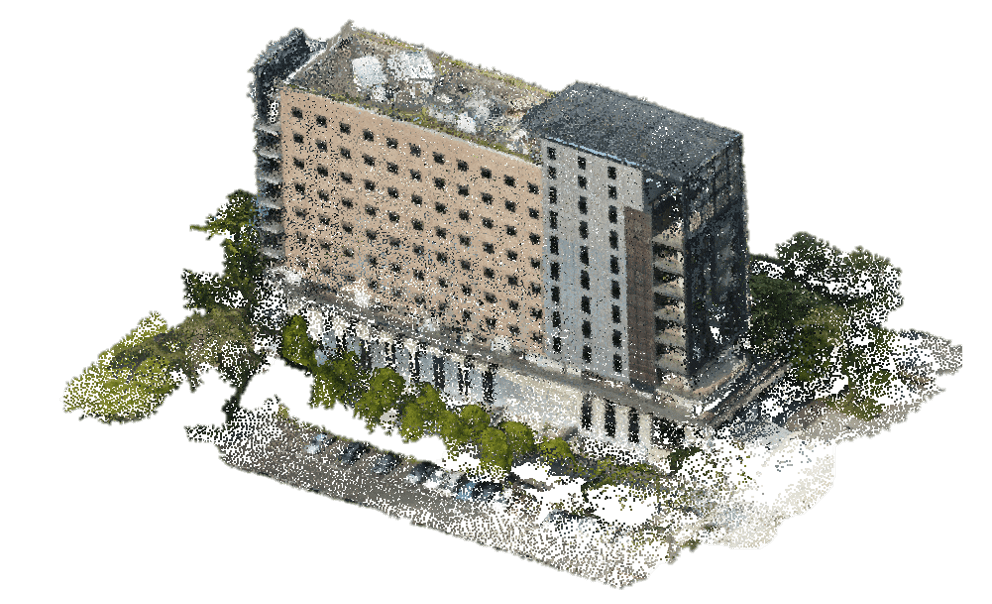
Transforming Construction Industry with 3D Point Cloud Data
3D point cloud data is transforming the construction industry! With the development of the computer’s hardware and algorithms, the acquisition of the point cloud data becomes easier. We can capture the 3D scene using our smartphone within several minutes. However, what are the applications of the 3D point cloud data and how are these valued? …
-
4 Steps to automate your daily repetitive tasks
Automation of workflows makes your life easier! I have explain the benefit of automation in this blog, please check it out if you are interested! By automating repetitive jobs, we can decrease the time spent on boring work and spend more time on work that requires creativity and focus. But this is easier said than…
-

FoundationStereo framework explained: 5 key features for zero-shot stereo depth estimation
FoundationStereo by NVIDIA presents a state-of-the-art stereo model excelling in depth estimation without any prior fine-tuning. This article introduces the stereo problem, why is it challenging, how does FoundationStereo solve it, and what are my opinions.
-

How does automation facilitate your workflow?
Are you bored with the repetitive tasks of your daily work? Like running in a circular path, doing the same thing repetitively, without an end. According to the Forbes article, the ‘boreout’ causes many people to feel depressed and want to leave their jobs. Now, there is a chance, to escape the endless loop, and…
-

Key Differences Between Photogrammetry and 3D Computer Vision
All interested in, or have just started learning 3D reconstruction knowledge, will be more or less confused by the differences between the terms photogrammetry and computer vision. Some may suggest that the reconstruction of the point cloud is based on photogrammetry, while others insist on 3D computer vision. It is important to know the differences…
-

Welcome to Pixel Decoder Blog
Pixel Decoder, run by friedfish, focuses on computer vision and photogrammetry, particularly in 3D reconstruction from 2D images. The blog aims to build a community through shared knowledge, covering theory, practical guides, and research. New content will be posted weekly, inviting topic suggestions from readers.
 Pixel Decoder